

The Philosophy of Time Travel
122 x 122 cm
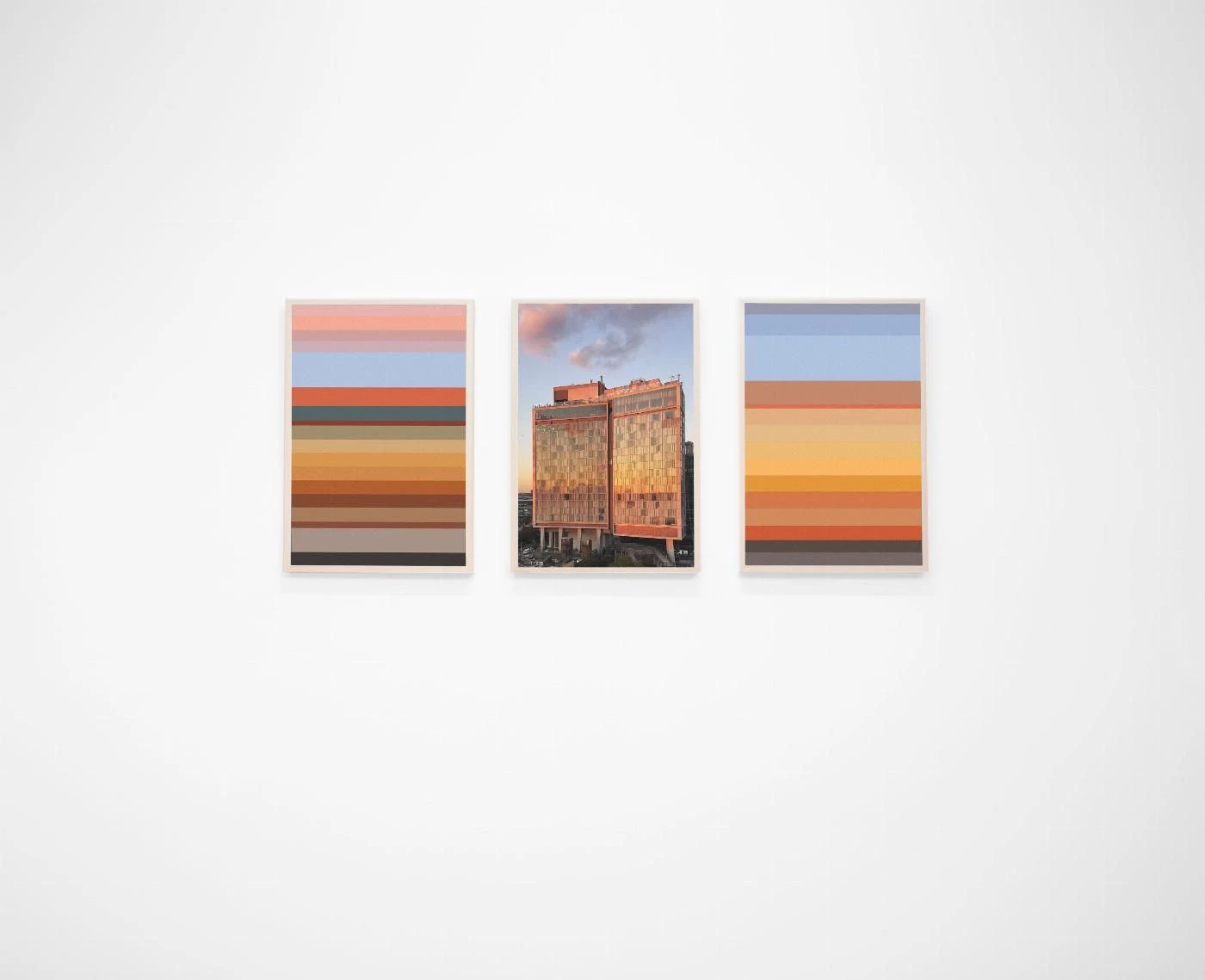
Translating architectural constructs into chromatic memories, where color language distorts time and spatial experience.
SERIES
The "The Nature of Time" series delves into the philosophical and scientific complexities of time, exploring the tension between its physical dimension and our subjective perception. Through references to presentism, eternalism, and the theory of relativity, it poses questions about the "arrow of time" and its apparent irreversible direction. The artist connects these reflections with the imaginaries of science fiction, where time travel and narrative paradoxes are speculated upon. Thus, the work combines conceptual rigor with a poetic approach, inviting us to question whether time is an external reality or a construction of consciousness. Ultimately, it reminds us that our experience of time is anchored in two vital coordinates: birth and death.
4 works in the series


SERIES
Stretching Landscapes is a series that investigates the elasticity of time and its relationship with memory. Starting from the idea of "stretching" minutes beyond their usual measure, the artist proposes a visual language that dilates the ephemeral and transforms it into an expanded experience. Inspired by the Tesseract from Interstellar — that multidimensional space where time is represented as lines of color — Ascencio establishes a parallel between perception, memory, and representation. In his works, he begins with a printed photograph that captures a specific instant, but which is extended through frames painted with acrylic. Using the colors of the original image, the pictorial gesture visually stretches the moment, as if memory were unfolding beyond the frame. The result is a dialogue between painting and photography, between the real and the remembered, reflecting how memories transform over time: they distort, they embellish, they dilute. Stretching Land
10 works in the series


SERIES
Ascencio's "Colour Studies" series explores the role of color as a historical and symbolic axis in modern architecture, from its primitive root in cave paintings to its aesthetic function in iconic buildings. The artist takes works by Barragán, Le Corbusier, Mies van der Rohe, and the Eames as references, using the same material as the original construction in each piece. With this, he translates emblematic buildings into chromatic studies that condense their visual and poetic identity. The series turns color into a vehicle of memory and emotional connection, evoking associations between architectural forms and personal experiences. Thus, it proposes a radical abstraction where color is a testament to history, matter, and perception.
2 works in the series


Works by Diego Ascencio Fuentes in the catalogue: A time of both | hope and conflict · Cuadra San Cristobal · Everything returns nothingness (Pasadena) · Everytime you justify another good on you dies · Fall down | never get back up again (Les jardins de Versailles) · I let the sun down without telling you exactly what I mean (Los Cabos) · I think of her when the sun goes down (The Standard NYC) · Stay Happy There (Arsenale di Venezia) · The Castle builders (Pompidou) · The Philosophy of Time Travel · The Philosophy of Time Travel - Back to the Future · The Philosophy of Time Travel - Prisoner of Azkaban · The Philosophy of Time Travel - Video Games · The poets down here don't write nothing at all (Little Island) · Then again | maybe you were right (LACMA) · Tourette's