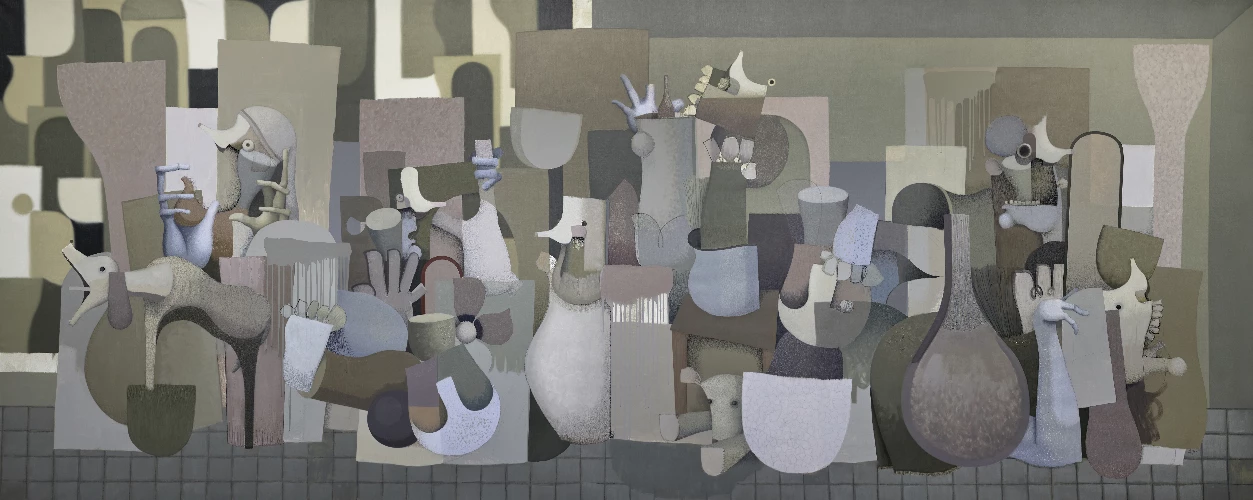
The true origin of the work GAZA could be the tension between the rejection of propaganda,
so common today, and the impossibility of indifference. More than a political manifesto,
it is evident proof of human irrationality. The composition functions as a contemporary frieze, a field saturated with forms that brush against each other, obstruct and protect each other. There are hints of bodies, faces, and remnants of everyday objects. From a technical point of view, the layered construction of planes stands out, the sensation of a pictorial collage that keeps everything in subtle balance. The palette, restrained and opaque, shuns spectacularity, the tones fade as if bearing dust, smoke, or time.
The work features a torn screaming woman, an elderly woman holding a child in her
arms, two dismembered dead warriors, a frightened hidden teddy bear. The
principal character in the center of the work screams to the sky, literally dislocated.
The work also has a certain macabre humor, the character located in the center of the work, the "bowling pin" woman, so named because the Palestinians appear like bowling pins waiting to be knocked down.
"The preliminary drawing of the bowling pin woman had an interesting expression that I liked, but then when I painted it I clearly saw that she was smiling, and that is something that, evidently, I did not want. So with some violent brushstrokes I blurred the smile she had; the smile was literally erased from her face."
One of the dead warriors appears dismembered next to a flower, a clear reference to Picasso's Guernica. A man with a totally lost, frightened gaze holds the torso of a child. A screaming woman, with very expressive hands,
dislocated. A dog barking towards where everything ends, imagining that other horrors
will occur outside the painting, terrified, inspired by the character in the right panel of
Francis Bacon's triptych Three Studies for Figures at the Base of a Crucifixion (1944). The dog,
completely terrified, appears with its tail between its legs.
The scene takes place in an "interior exterior," a concept very similar to that of Guernica,
where one does not know if the figures are indoors or outdoors. In this case they are
clearly indoors, but at the same time, buildings and constructions appear. Each gaze is
different, the pupils are snatched away, widened, or droop from the characters, they cannot
bear such a scene. Brushstrokes also appear that recall the waterfalls of Pat
Steir or certain brushstrokes from Robert Rauschenberg's Combines, in this case
symbolizing the destruction of bombs. Contrary to what is usually done with works of art, Gaza is read from right to left, as it was painted in this way, wanting, in addition, to resemble Arabic writing, perception, and sensibility.
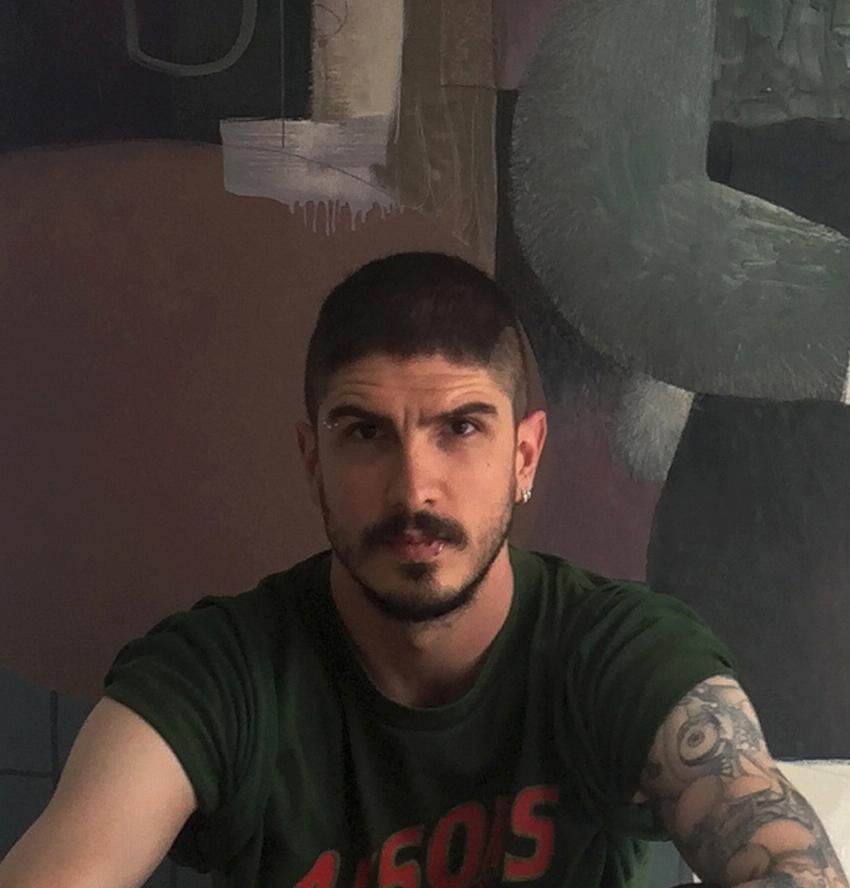
Carlos Blanco is a visual artist who stands out for his meticulousness and for solving a highly complex formal problem: how to display a tumultuous, deformed reality with successive agglomerations in a completely harmonious and aesthetically pleasing manner. Nothing he presents is the result of chance; his harmonious color palette, balanced compositions, rich textures, and continuous experimentation with volume and stroke demonstrate exhaustive preliminary planning. His technical and formal rigor prevail over conceptual depth, which seems to be subjected to a dance between the traditional values of plastic arts: color, composition, texture, stroke, volume, and depth.