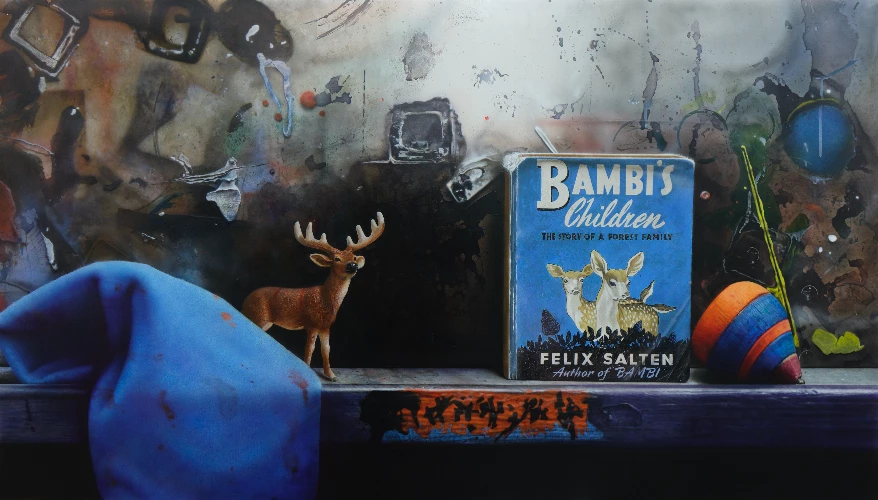
In the painting "Bambi", each object represents an aspect of the story, forming a visual symphony that evokes emotions and teachings. The book "Bambi", this central element, is more than just a piece of literature; it is the vehicle for the memories and lessons that the tale offers us. Its presence in the painting sets the tone for the work, reminding us that the stories we read can have a lasting impact on our worldview. Thus, the book becomes a symbol of wisdom and the connection between generations, where the same themes of innocence and loss are transmitted timelessly.
The story written by Felix Salten was banned in Nazi Germany for its metaphorical content, which alluded to the extermination of Jews. It is a tale in the form of a fable that presents a more serious reflection than what Disney presented to us at the time. On the shelf, accompanying the book, there is a toy deer; it is the tangible reflection of Bambi in its most vulnerable and innocent form. The red spots adorning its surface indicate not only imperfection but also the scars of difficult experiences that mark our lives. Just as Bambi faces the cruelty and beauty of his environment, the toy deer reminds us that innocence can be tarnished by the internal and external struggles we all face.
A sky blue cloth with its stains symbolizes the safe and familiar space that we often associate with childhood. In the narrative of "Bambi", the happiness and lightness of the early days contrast with the challenges that come later. This element, due to its color and being a cleaning element, could be the emotional refuge provided by family and friends, who help us clean the negative emotions that stain our path.
There is a brightly colored spinning top that, despite being a toy, in Salten's (Jewish) culture, became a symbol of struggle and the perseverance of faith as a solid weapon to defend our convictions.
Behind these elements, a dirty paint palette emphasizes that creation and experience are linked to imperfection. Each stain is a testament to the art of living, where stories intertwine and emotions are captured in a chaotic palette, just as in the landscape surrounding Bambi, our reality is full of layers, nuances, and complexities.
Together, these objects not only represent visual elements but function as metaphors that encapsulate the essence of "Bambi". Together, they tell a story of growth, struggle, and redemption, where each piece invites us to reflect on our own journey through life.
Lorenzo Fernández's work is based on a profound exploration of hyperrealism as a poetic and conceptual language. His painting, executed without photographic support and based exclusively on direct observation, reclaims the technical tradition of painting on board to achieve a precision that transcends mimesis. Each object, surface, or atmosphere is treated as a potential symbol, a trigger for memory, or a silent form of narration.
Far from documentary coldness, Fernández uses technical rigor to intensify the emotional. Light, compositional order, and emptiness acquire a structural role: they are the elements that articulate the psychological dimension of his scenes. His works propose a contemplative experience where the everyday becomes an enigma and where each element —however insignificant it may seem— speaks of the fragility of time, the persistence of memory, and the mystery of reality.