Psyche and Eros:
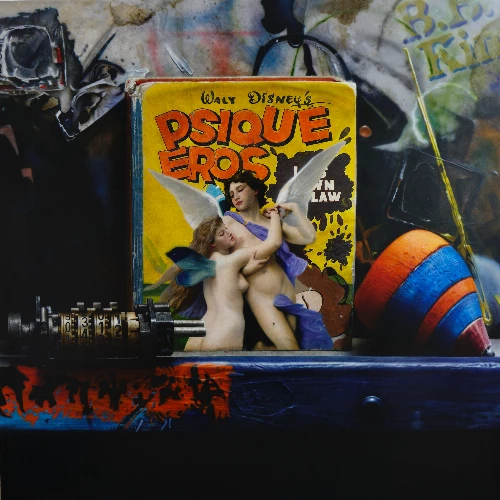
In this work, a visual dialogue is presented between eternal love and the essence of curiosity. In the central area of the painting, a book titled "Psyche and Eros" stands as a beacon of knowledge, evoking Greek mythology and the deep love that unites these two iconic characters. The depiction of Psyche and Eros, captured by Bouguereau, invites the viewer to explore the complex tapestry of their story. Psyche, a maiden of extraordinary beauty, captivated even Aphrodite, goddess of love and beauty, who ordered her son Eros, the god of love, to make her fall in love with the most despicable creature. However, Eros, upon seeing her, was so captivated by her beauty that he decided to keep her safe. Despite challenges, including jealousy and trials, Psyche seeks to regain her love, leading her on a transformative journey towards adulthood and divinity. This tale is a symbol of the soul's quest, where the union of love and wisdom guides us towards self-understanding.
Objects and Their Symbolism.
The central book not only presents the tale of Psyche and Eros but also symbolizes the pursuit of knowledge and life experience. The colorful labeling, with the "World Disney" mark, adds a contemporary nuance to this classic narrative, suggesting how love stories transcend generations and continents, adapting for new audiences.
On one side of the book, the orange and blue striped spinning top represents, in this case, the playfulness and innocence of childhood, essential elements in genuine love stories. It echoes the dance of Eros and Psyche, whose relationship is a balance between passion and fun. The spinning top turns, symbolizing the constant movement of life and love, the ebb and flow of happy moments alongside challenges faced together.
On the other side, the turn counter of an antique artifact evokes the passage of time, reminding us that love, like the cycle of seasons, requires patience and care. This object speaks of the continuous commitment that Psyche and Eros must maintain to sustain their bond, as well as the different stages they go through in their relationship.
The shelf painted in violet, adorned with invented Chinese letters, adds a sense of mysticism. The color violet, associated with spirituality and creativity, suggests that love and wisdom are cosmic forces that transcend human understanding. The paint marks on the background board tell untold stories, showing that each work of art is a palimpsest of experiences, a place where dreams and realities intertwine.
Conclusion:
"Psyche and Eros", in this visual and symbolic context, invites reflection on the nature of love in all its forms; from innocent play to mature commitment. By addressing mythology and its contemporary resonance, this work becomes a bridge between the past and the present, reminding us that the stories that unite us are as ancient as time itself, but can always be reborn in new interpretations, just like love that endures through the centuries.
Lorenzo Fernández's work is based on a profound exploration of hyperrealism as a poetic and conceptual language. His painting, executed without photographic support and based exclusively on direct observation, reclaims the technical tradition of painting on board to achieve a precision that transcends mimesis. Each object, surface, or atmosphere is treated as a potential symbol, a trigger for memory, or a silent form of narration.
Far from documentary coldness, Fernández uses technical rigor to intensify the emotional. Light, compositional order, and emptiness acquire a structural role: they are the elements that articulate the psychological dimension of his scenes. His works propose a contemplative experience where the everyday becomes an enigma and where each element —however insignificant it may seem— speaks of the fragility of time, the persistence of memory, and the mystery of reality.