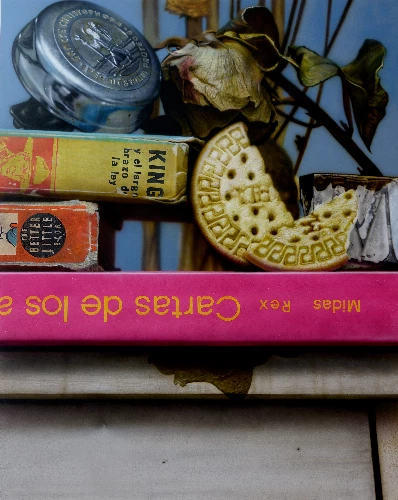
This painting is a visual meditation on the paradox of abundance and the tragedy of fulfilled desire. By titling it "King Midas," the work invites us to look beyond objects and find the "curse" in the everyday.
First, it addresses the futility of wealth (Dead Matter). In the myth, everything Midas touched turned to gold, representing the victory of wealth over life. In this image, we see a cookie—a symbol of nutrition and immediate pleasure—that seems to have become rigid, almost stony, losing its vital function.
Existentialist philosophy would tell us that the value of things lies in their use, not their possession. By turning food into an object of display (or symbolic "gold"), its essence is nullified. A feast that cannot be eaten is the definition of a materialist hell.
Second, it deals with time and aesthetic corruption. The presence of dried flowers and worn books ("The Better Little Book," "Letters from the...") acts as a Memento Mori. King Midas sought eternity through precious metal, but reality is entropy.
The tension: There is a contrast between the solidity of metal (the bicycle bell of Saint Christopher) and the fragility of paper and withered petals.
The lesson: Even that which "shines" or claims to bear witness (books) is subject to decay. Beauty here is not that of perfection, but of loss.
And finally, it deals with the inversion of order. It is fascinating to note that the pink book in the foreground has inverted text. Philosophically, this suggests a distortion of perception. Midas did not see the world as it was, but through the filter of his own greed.
The arrangement of objects—piled up, almost suffocating each other—reflects a saturated mind. When we possess everything, we lose the ability to distinguish the importance of each thing. The "King" of this image inhabits a realm of fragments, of unread letters and uneaten cookies.
Ultimately, "King Midas" is not a painting about gold, but about the solitude of the object. It reminds us that true wealth is not the accumulation of matter, but the ability to let life be organic, ephemeral, and therefore real. There is a positive message in the painting: that bell, suggesting we walk with faith—it doesn't have to be religious faith; it's faith in ourselves that helps us move forward in our life journey.
Lorenzo Fernández's work is based on a profound exploration of hyperrealism as a poetic and conceptual language. His painting, executed without photographic support and based exclusively on direct observation, reclaims the technical tradition of painting on board to achieve a precision that transcends mimesis. Each object, surface, or atmosphere is treated as a potential symbol, a trigger for memory, or a silent form of narration.
Far from documentary coldness, Fernández uses technical rigor to intensify the emotional. Light, compositional order, and emptiness acquire a structural role: they are the elements that articulate the psychological dimension of his scenes. His works propose a contemplative experience where the everyday becomes an enigma and where each element —however insignificant it may seem— speaks of the fragility of time, the persistence of memory, and the mystery of reality.