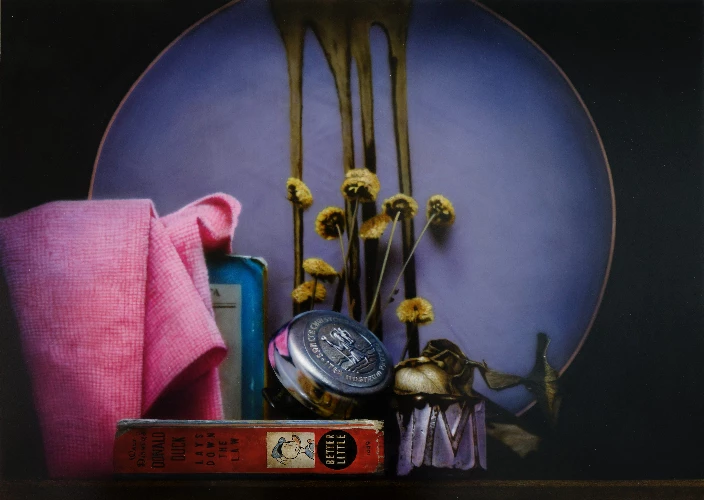
"The Judgment of King Midas" is a visual meditation on transmutation, loss, and the paradox of value. Unlike classical depictions that place the king in a suffocatingly opulent palace, this work shifts the myth to the realm of the everyday, the intimate, and perhaps, the forgotten.
1- Gold as a Stigma and Curse: At the center of the composition, dried flowers appear to have been touched by Midas's "golden touch." But this gold does not gleam with the promise of wealth, but with the heaviness of inertia. The philosophy of the Midas myth warns us that absolute desire is, in reality, a desire for death: by turning the organic into metal, the King annihilates life.
The golden stains dripping from the top of the violet plate suggest a wealth spilling like a wound, a contamination descending upon the humblest objects.
2. The Dialectic of the Everyday: The presence of seemingly trivial objects —a pink rag, a "Donald Duck" comic book, and a Saint Christopher bicycle bell— creates a profound contrast:
The Book and the "Judgment": The title of the book, "Donald Duck Lays Down the Law," ironically dialogues with the painting's title. Ño judges whom? Midas's judgment was his own condemnation. By placing an element of mass culture against an ancient myth, the work suggests that human ambition and its consequences are universal, from Greek tragedy to modern comedy.
The bicycle bell with the image of Saint Christopher: The patron saint of travelers, whose motto reads "Aspice Sanctu Christophorum et tutus viam carpe" (Look to Saint Christopher and continue your journey safely), represents the search for protection in a world where everything we touch risks withering or becoming rigid. It is faith against greed.
3. The Aesthetics of the Modern Vanitas: This painting functions as a contemporary Vanitas. The objects are arranged on a dark surface, emerging from the shadows to remind us of transience:
The pink rag represents labor, the body, and the tactile; that which Midas can no longer feel without destroying.
The violet plate acts as a halo or a static moon, a circle of geometric perfection that frames the decay of the flowers.
In conclusion, "The Judgment of King Midas" invites us to ask ourselves: What have we turned into "gold" today at the cost of our own humanity? The work suggests that true judgment does not come from an external tribunal, but from the silence of the objects around us, mute witnesses to our inability to let life simply be, without trying to possess it or transform it into something "valuable."
Midas is not just a legendary king; he is modern man who, in his eagerness to capitalize every moment and every object, ends up surrounded by a cold, inert, and profoundly lonely beauty.
Lorenzo Fernández's work is based on a profound exploration of hyperrealism as a poetic and conceptual language. His painting, executed without photographic support and based exclusively on direct observation, reclaims the technical tradition of painting on board to achieve a precision that transcends mimesis. Each object, surface, or atmosphere is treated as a potential symbol, a trigger for memory, or a silent form of narration.
Far from documentary coldness, Fernández uses technical rigor to intensify the emotional. Light, compositional order, and emptiness acquire a structural role: they are the elements that articulate the psychological dimension of his scenes. His works propose a contemplative experience where the everyday becomes an enigma and where each element —however insignificant it may seem— speaks of the fragility of time, the persistence of memory, and the mystery of reality.